
Creative thinkers, entrepreneurs and experts from the sector, including people with lived experience, came together at Coventry University’s Technopark for two days of idea generation and prototype trialling. Five finalist teams were selected to present their ideas at The Care Show, the largest care event in the UK, on 12th-13th October at the NEC in Birmingham. Good luck to the finalists: Team Care Tech Guide, Team Chip, Team Fall Free, Team Myghty and Team Star. The winning team will receive £1,000 in prize money, media coverage and mentoring to develop their idea.
Introducing Team Fall Free
 Image caption (left to right) Mutong Li , Ethan Booth and Kourosh Simpkins.
Team members Ethan Booth and Mutong Li are both studying an M.Sc in Applied Infectious Diseases Epidemiology at University College London (UCL) and are mid-way through their dissertations. I applaud Mutong’s commitment to join the call – he apologies for the slight signal break up, whilst he navigates his way around a train station in Hong Kong. Kourosh Simpkins is studying a B.Sc in creative computing. I can see why the judges said they loved the team’s charisma! They can’t stop smiling and despite being thousands of miles apart at that very moment, they were very much in sync with one another.
CMM: So, what brought you to the Care Innovation challenge?
Team Fall Free (Ethan): It’s a funny story because we came to the forum with a different idea – which was a software to assist researchers with literary review. We then discovered that the care forum wasn’t related to what we were trying to pitch, so we had to come up with a different idea on the spot!
We thought about our skills and strong statistical backgrounds and how certain health concerns/diseases can be predicted. Our mentors, Mei-ling Huang of RWK Goodman and Atholl Craigmyle of Hilton Nursing Partners suggested that we explore fractures.
CMM: What is your idea in a nutshell?
Team Fall Free (Kourosh): We are trying to develop software that uses your medical information, such as your age, gender and BMI, to predict your risk of fractures in the next three months. The technology would also aim to assess your risk of having a fracture and would make personal recommendations to reduce that risk.
CMM: Who is your target audience?
Team Fall Free (Ethan): We would target two groups of clients; families and individual people and health and care organisations who work directly with people, such as care homes. We are building an app, which is connected to the database, for family members to use. There will be one centralised database. Social care organisations will have access to a web interface – just like an excel spreadsheet.
CMM: What market research did you do?
Team Fall Free (Ethan): I spoke to my dad – he’s 75 years old – to get his thoughts. We also considered how it might work for carers, such as an unpaid carer caring for an older relative. There is potential to look at a chat function, where you can be put in touch with a GP. We could also reach out to some of the companies who are doing this and try to form
a partnership.
CMM: Have you explored your competitors in the space?
Team Fall Free (Ethan): We are familiar with Xantura – I believe they collect data from individuals to estimate a risk of hospital admissions for all causes. Our unique selling point would be our specialism for estimating fracture risk, and providing personalised recommendations, essentially an orthopaedist in a pocket, if you will.
CMM: Have you considered the finances of the app?
Team Fall Free (Kourosh): We are thinking of charging £8.33 per month as a subscription. It would be cheaper for care homes due to the higher volume of clients. The main hurdle is that it’s an app, so we need to pay for technology monthly. The days of free apps are long gone. As more people sign up, we may be able to lower the price.
CMM: How would you describe the Care Innovation weekend?
Team Fall Free (Mutong): The judges said they really liked our charisma! The mentors really liked how we worked together as a team. It was a new experience for us, it was fantastic. It was worth it!
Introducing Team Star
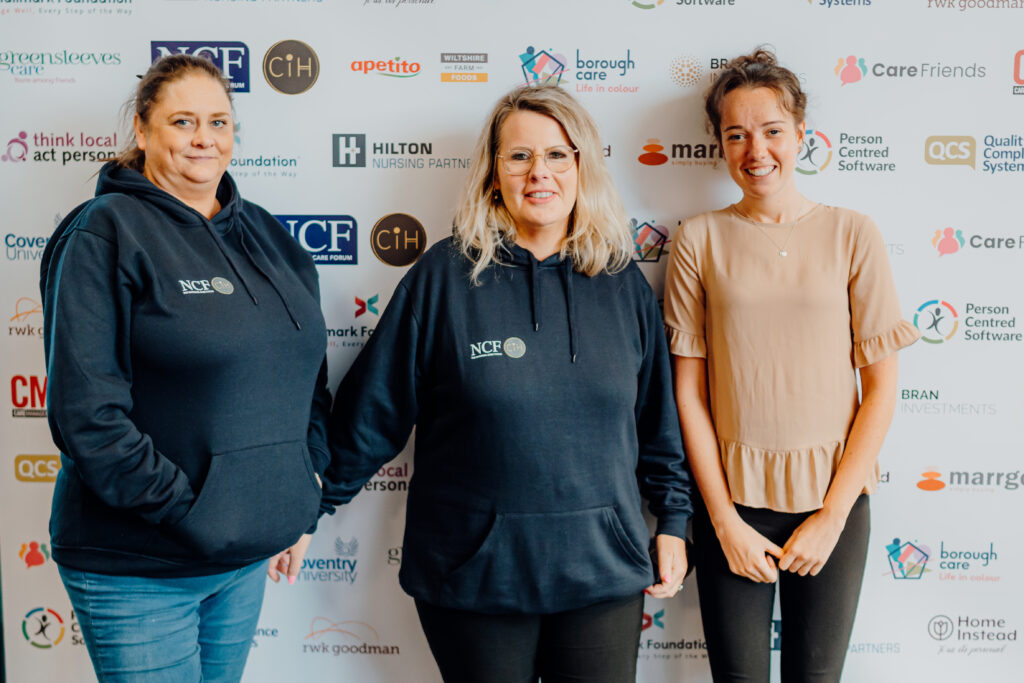 Image caption (left to right) Claire Dineen, Tracey Wakeling and Lizzi Jordan.
Tracey Wakeling is Registered Manager of two Green Square Accord extra care schemes in Coventry. One is for people with dementia and the other is for people with mental health and learning disabilities. Claire Dineen is the Deputy Manager at Green Square Accord’s Arden Grove and has been working in care for 26 years. They both started in the care sector as care workers. Tracey and Claire united with Lizzi Jordan – an engagement and inclusion officer at Surrey Choices – at the Care Innovation weekend.
CMM: What’s your innovation idea?
Team Star (Tracey): We are offering the idea of local reablement and assessments with housing for people living with dementia. Not enough people with dementia get accepted into reablement. People think that reablement is something we have all over the country, but we aren’t actually meeting people’s needs. Although we are focusing on people with dementia initially, this is something that can be rolled out to other areas, such as learning disabilities; it could have many different models under it.
CMM: What’s your plan to progress the project?
Team Star (Tracey): We are looking at doing a six-week pilot programme, where people can come and work with the staff at Arden Grove, to see if we can work with these people to get them to a stage where they can remain in extra care and avoid going into residential care. The staff will be upskilled via a programme which isn’t currently used in extra care called RESTORE 2; staff will be trained to take oxygen levels, blood pressure, to do sugar testing and urine testing. This will help staff to identify early signs of deterioration.
We need to talk to people with dementia, mental health social workers and understand the criteria – what the areas might be for people not meeting the criteria for extra care. Claire and I are already booked onto the training which is taking place this month (September) and there’s another staff member who is booked on.
We would focus on one flat initially and the company I’m with now would fund for the refurbishment of the flat – they would invest probably £3,000 for the refurbishment and the commissioners would pay for the rental of the flat. Then they would block fund maybe 15 hours a week to provide the care for those individuals receiving care. I’m not in it to make money. It’s a gap in social care.
CMM: What’s the evidence for the need?
Team Star (Tracey): According to Coventry City Council, over the last six months, 36.9% of people have moved into residential care unnecessarily. Our programme is not going to be the solution for everyone, but it will give people the opportunity to meet the needs of people needing care.
Team Star (Claire): We have a lady who needs to go to residential care, but there are no beds because they are being taken up by people who don’t actually need those beds. We are trying to avoid residential care and work with people because their care plans might not be accurate. It’s not fair on managers if you can’t meet the person’s needs who you are looking after. It’s not fair on them and it’s not fair on us.
CMM: Who would benefit from the service in particular?
Team Star (Tracey): The dementia and mental health managers are saying that there are so many more people coming through now with Korsakoff’s syndrome, also known as ‘Wernicke-Korsakoff syndrome’, a non-progressive type of dementia which is most commonly caused by chronic alcohol abuse. However, people with Korsakoff can come back to the stage of being quite independent. With some work, down the line, people can live independently again. There is no risk of bed blocking, they already have their place, then they move on.
I think it would drastically reduce the need for residential care. You look at people in there who don’t need to be in there, they are taking the places of people who really need to be in there. Everyone is being let down. If someone put me into a bedroom and said, ‘this is where you’re living now’ the effect it would have on you mentally is excruciating.
CMM: Who has supported you with the project?
Team Star (Tracey): There is obviously interest; the managers of mental health and dementia said they have been crying out for something like this for ages to come into the system. The reablement brokerage team are saying that it makes them so happy because this is something that we don’t have. Professor Vic Rayner OBE and Professor Martin Green OBE were both very supportive and we have had meetings with them. I spoke to Coventry City Council and it’s something that they are excited about. I also spoke to the manager of Dementia and Mental Health in Coventry, and he said this is something that’s really needed.
CMM: Lizzi, what prompted you to join forces with Claire and Tracey?
Team Star (Lizzi): I think Tracey and Claire’s approach is to have people’s best interests at heart, which was really refreshing. Tracey and Claire have so much experience in the sector and lived experience and they have noticed that gap in the market. Sometimes the best ideas come from people with the best experience.
One of the things that I found really interesting from the weekend was not just about how the idea helps people remain independent for longer but how it is so much cheaper than residential care which is a massive bonus and will allow people more access. The average cost for residential care in Coventry is between £800-1200 a week, extra care is £237.
CMM: Have you been surprised about how quickly the project is developing?
Team Star (Tracey): We started off with an idea, but we have learned so much along the way – through people we have met, meetings we have had. Things have really surprised us. It’s going to be of benefit to staff because they are going to have extra skills, so hopefully it will have a good impact on the workforce. It’s a winner all round really.
Introducing Team Care tech guide
 Image caption (left to right) Liam Palmer, Professor Vic Rayner OBE.
Liam Palmer runs five care homes in Gloucestershire and has been working on his innovation project for a few years. He tells me he was a bit reluctant to attend at first because he didn’t want people to think Care Tech Guide were pretenders! After a conversation with Professor Vic Rayner OBE, any anxieties quickly subsided.
CMM: Liam, tell us about your background to working in care.
Team Care Tech Guide (Liam): In 2018, I did my Level Five diploma in social care. I was running an 80-bed care service at the time. It was all paper based and one of the residents lost half a stone over a two-week period and it got missed because of the crossover of staff. I worked in logistics before care and I thought, surely there could be a system that could give you an alert?
I did my final project for my Level Five on researching planning systems for care. I found that there were some very specific gaps in the market for social care. I thought if I was going to do something here then we need to determine what’s good technology. So, we started with defining standards for tech. I partnered with a research care company and my co-founder, Louie Werth, who is doing his PHD at Cambridge in Research, because I needed someone to cover the information data part.
He then said in a moment of clarity that we should do something like Money Supermarket for care technology. We should make it simple and accessible. We put our efforts into developing something that was a hybrid between a Which? guide, Money Supermarket and Google. We know those ideas work. The significant thing was to take ‘Tech for Care’ and put a boundary around it to show that it warrants attention. The potential is huge – social care is enormous.
CMM: How does the software work?
Care Tech Guide (Liam): We are helping people to draw up a shortlist of technology they might want to use. We will share articles to offer users some inspiration or, if a user has a clear idea of what they want, we will signpost accordingly. It’s going to be about education – we aren’t going to do a ‘which is best’.
The online search is really underdeveloped. What we learnt from the innovation weekend is that the big barrier for providers is time. When we spoke to suppliers, they said they would invest in it. We have got a brand, a logo, we have a website, three investors and it’s being built now. Before the finals, we are going to build our own CRM and by the finals, we are hoping to have our finances in place and then we can formally introduce it to providers. Soft launch will be in Jan – it’s a big piece of work. I have a virtual PA!
CMM: Has anyone else attempted to this idea?
Care Tech Guide (Liam): The people who tried before were assuming that people knew the brands and were waiting for reviews. There isn’t anyone doing It really well. That’s me being a bit obsessive with it! I think I am like that because I’m a care provider and I understand the market very well. I’m interested in tech that is helpful and deals with a genuine problem. I know where the pain points are because I’m running care services.
CMM: What market research did you do?
Care Tech Guide (Liam): I used my podcast as a way of understanding what people have done and to see if it had legs! I was then confident that no one else was doing this and that we know the stakeholders will support it. Because it’s a whole market solution, the whole market needs to support it. People like Katie Thorn at Digital Social Care have been great supporters of the project. By having those conversations with industry leaders in care, I was able to understand if anyone else was trying this.
CMM: What do you think has made some providers reluctant to embrace technology?
Care Tech Guide (Liam): It’s about empowering people who know how to run their businesses and we believe that given the right information, they will be able to choose the right tech as well.
I think it’s the lack of reliable information – everyone says, ‘my software is the solution’. It’s that lack of neutral voice. What we really want to do is to help people who don’t know where to start and write mini articles to explain the fundamentals of each technology. Do you start with rotas or digital care planning? If you haven’t got much structure, then digital care planning is quite chaotic.
This is where we want to have a library of articles on each technology. For people to keep dipping into and getting their heads round. They can start building a picture – almost like a digital strategy. I think it’s going to create a community.
CMM: What would be your overall vision and goal for the future?
Care Tech Guide (Liam): We would like to get embedded into the various ecosystems within social care. Whether we are a finalist or a winner, NCF can say that this came through us. We are part of this movement and doing this with all the key players. Hopefully, it will be a benefit for many parties.
CMM: Have you considered how the project will work commercially?
Care Tech Guide (Liam): Suppliers will pay for it as a form of marketing and there will be add-ons. My first research was with 70 suppliers, and I have contacted every single one. In terms of route to market, we are thinking of putting everyone up there and doing it for free initially. You have to register as a care provider to access it.
People could try and copy this idea and do a basic listing service but there is so much thought that’s been put into this. We work with key organisations; we are hoping that our standing in the social care community protects us.
CMM: How would you describe your overall experience of the Care Innovation weekend?
Care Tech Guide (Liam): It was exhausting! It was really intense. It was a very well-structured process and there were mentors all over the place, dropping in. I had never done anything like that before. It was a really uplifting environment. I think the mentors helped with collaboration and we were all working to bring concepts to life – it wasn’t competitive.
We are honoured to get into these finals, we support all the other finalists and it’s about the good of the sector. I’ve heard the final is going to be a bit Britain’s Got Talent with Chief Executives of care providers judging! I’m going to demo/present a well-developed solution and we will rest on that – not personality or charm – youth is obviously not on my side! Let the best group win!
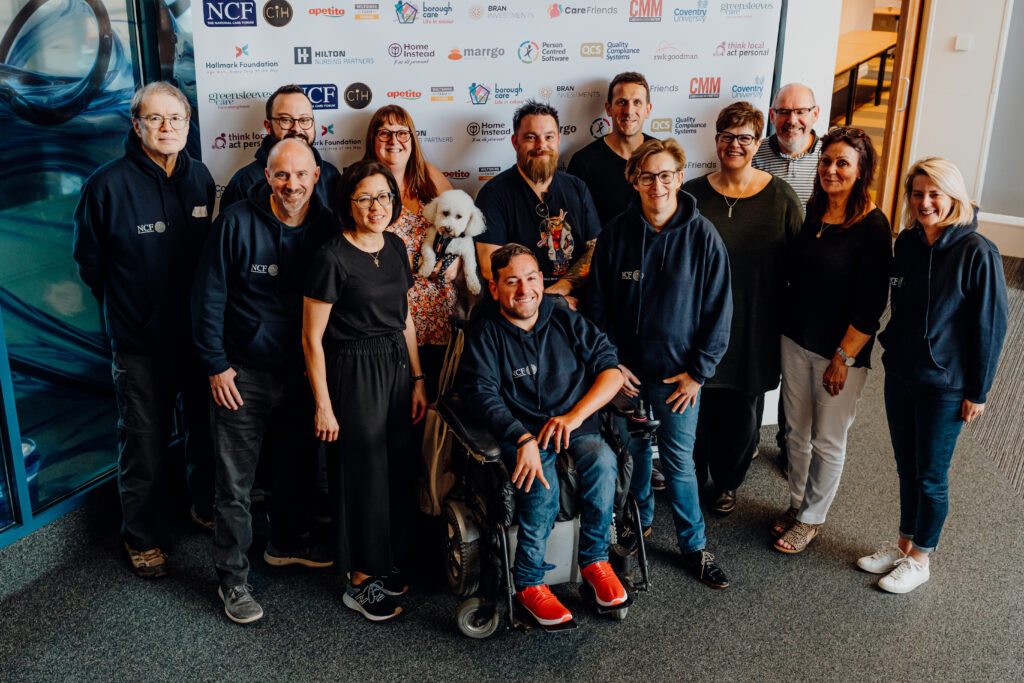
The five finalist teams, and their mentors (pictured above), will be showcasing their ideas at the Care Innovation Hub, Stand K20 (opposite the Beer and Bubbles Bar) at The Care Show on 12th-13th October, NEC Birmingham. The winning team will be announced at 1.45pm on 13th October in the Business Theatre.
For more information about the Care Innovation weekend, visit https://careinnovationhub.org.uk/
To contact Team Fall Free, email [email protected]
To contact Team Star, email [email protected]
To contact Care Tech Guide email [email protected]
Related Content
Using social media to create a positive perception of social care